ESM-2 (evolutionary-scale prediction of atomic level protein structure with a language model)
Highlights of the ESM-2 Paper
1. Introduction
1.1 — Structure and function are hidden in sequences
Biological properties of proteins influence which positions in a sequence can undergo mutations. From these observations, we can identify evolutionary patterns such as coevolution and conservation of amino acids. These patterns can help us infer properties of protein function and structure.44 In essence, information about protein structure and function is hidden in sequences.
Usually, we align sequences before drawing conclusions about function and structure. This intermediate representation, known as a multiple sequence alignment (MSA), has a high time complexity because we must first search for related sequences and then align them.55 The search process in AlphaFold and RoseTTAFold pipelines can take more than ten minutes.
What if we can get rid of this intermediate representation? That’s one aspect this paper accomplishes.
1.2 — Large language models (LLMs)
Historically, language models were pretrained using objectives such as predicting the next word in a sentence. Devlin et al.‘s BERT showed that masking some input tokens and predicting them—the masked-language-model objective, or MLM—is an effective pretraining strategy.66 Unlike left-to-right pretraining, the MLM objective lets the representation combine both left and right context, enabling a deeply bidirectional Transformer (paraphrased from the BERT paper).
1.3 — Contributions
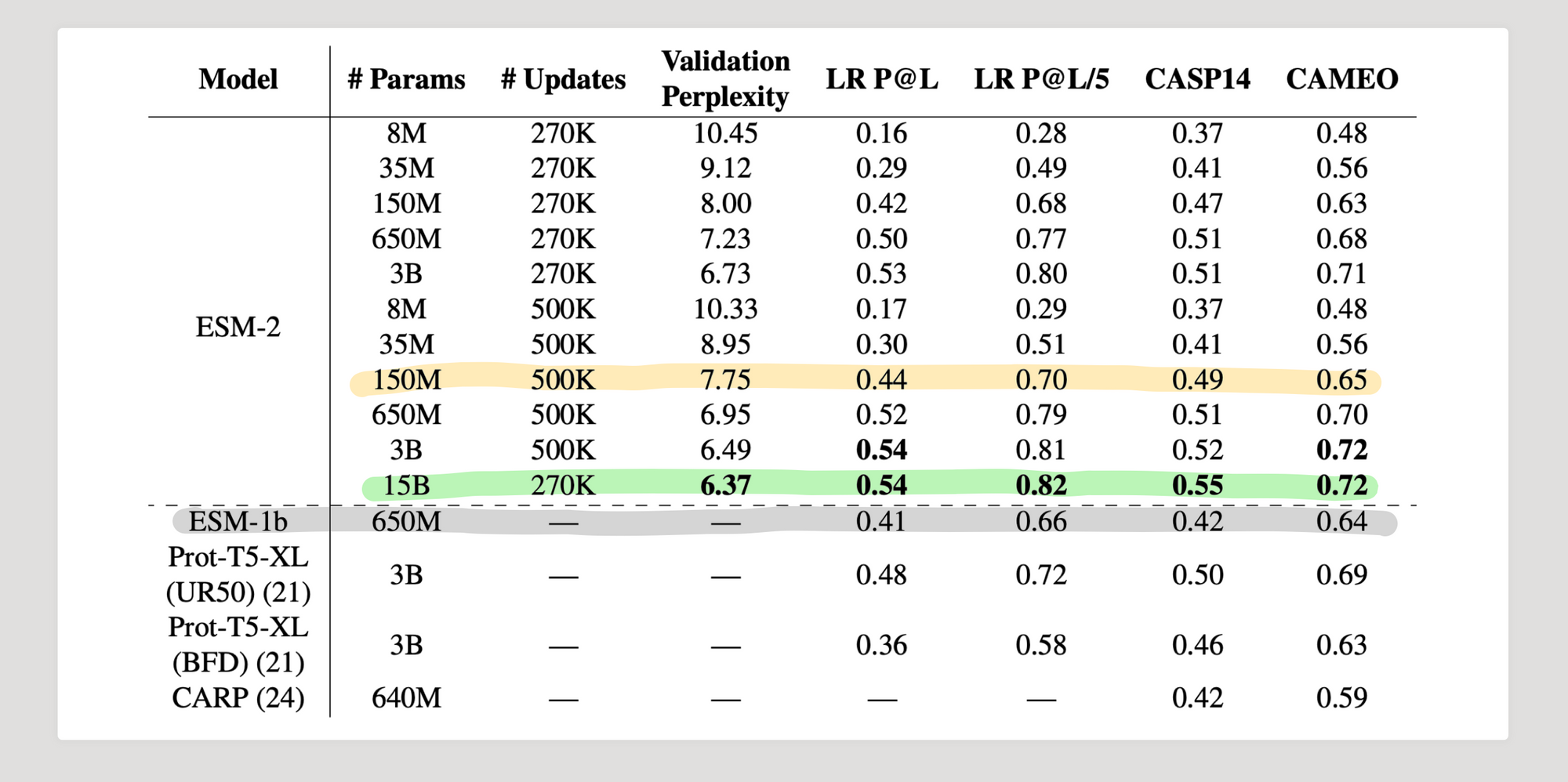
Inspired by this widely adopted strategy, the authors hypothesise that filling in missing amino acids might produce representations rich enough to infer structure. They therefore scale protein language models from 8 million parameters up to 15 billion parameters. Doing so reveals the following:
- Atomic-level structure prediction directly from sequence.
- A strong correlation between perplexity and structure-prediction accuracy.
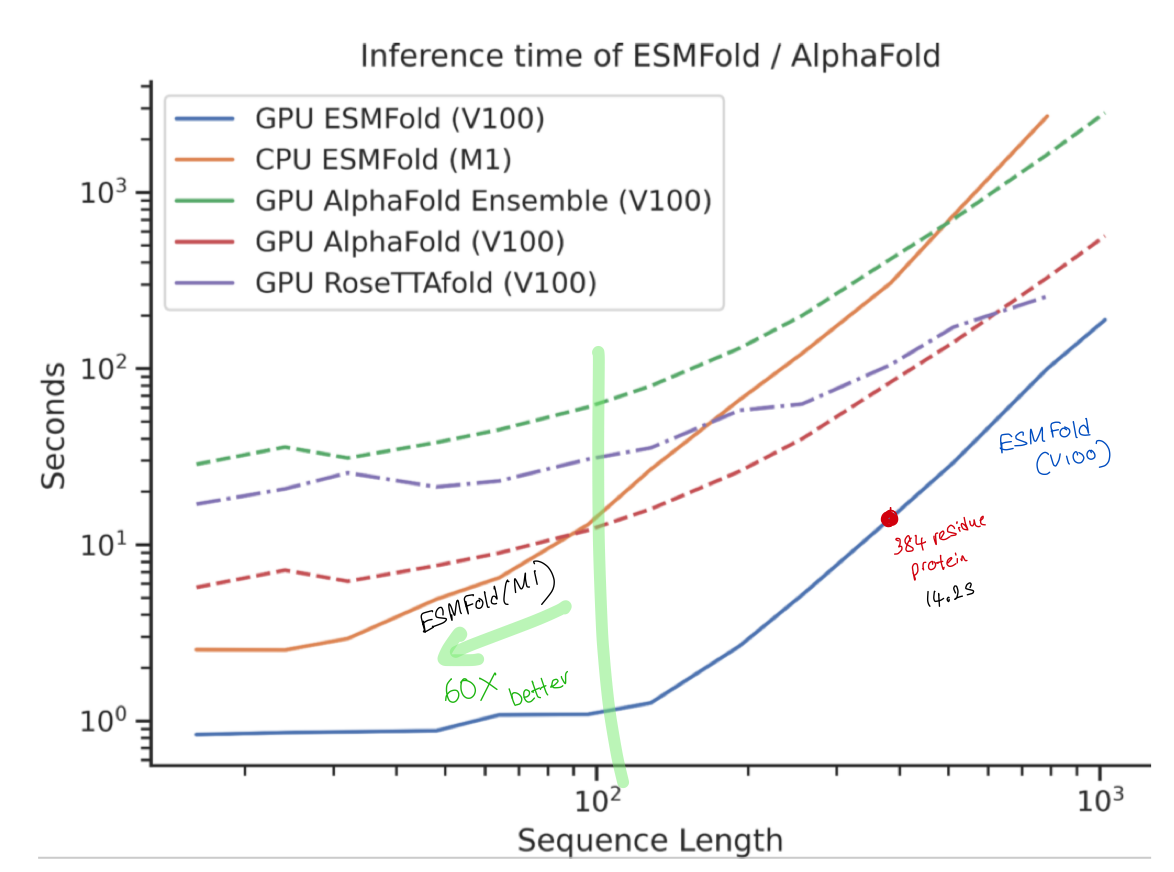
- Up to 60× faster inference.
- No need to search for related sequences.
Because this approach improves speed by one to two orders of magnitude and does not need an MSA, the authors expand structure prediction to the much larger and more diverse space of metagenomic proteins. In summary, they:
Predict structures for more than 617 million sequences in MGnify90.77 This took two weeks on 2,000 GPUs. 🤯
Of those structures, 225 million are high-confidence predictions.
- 76.8% are disjoint from UniRef90 at 90% sequence identity.
- 12.6% have no experimental ground truth.
2. Method
2.1 — How does structure emerge from a language model trained on sequences?
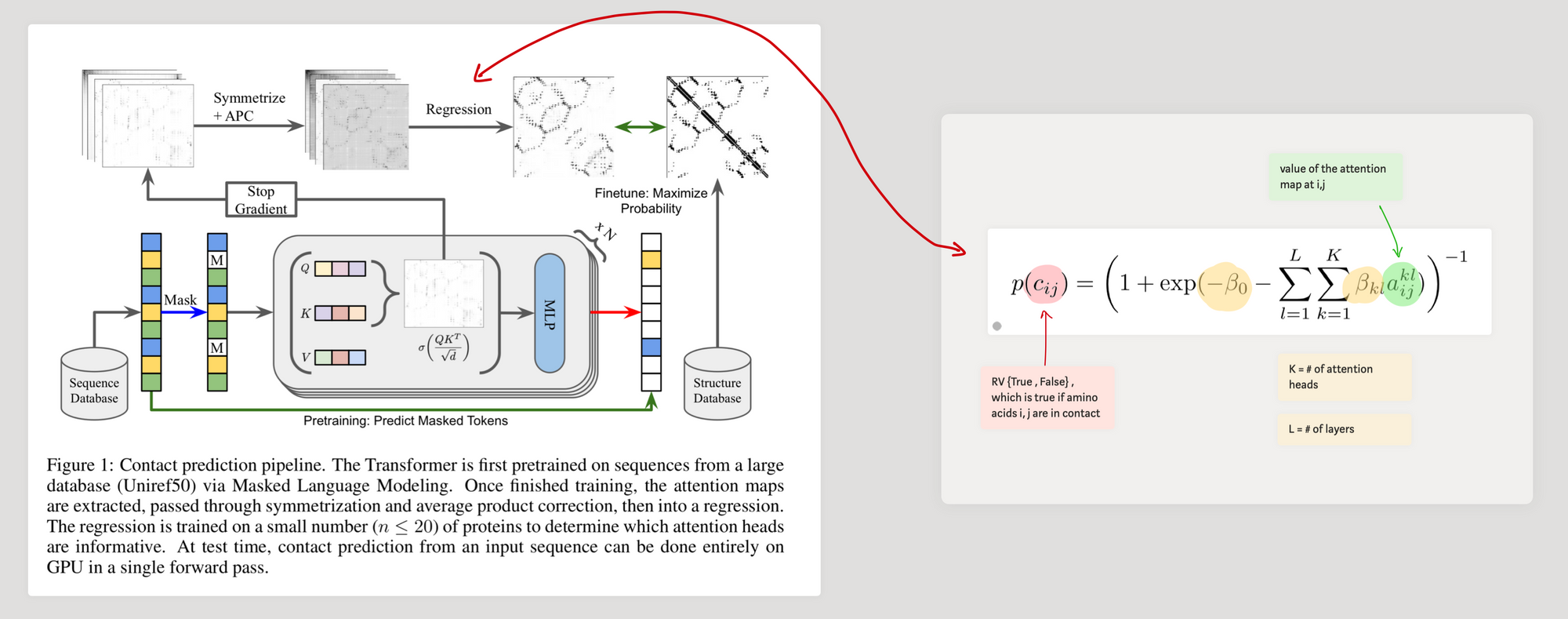
The ESM-2 language model is trained with approximately 65 million unique sequences.88 The sequences were sampled with even weighting across approximately 43 million UniRef50 training clusters. Because the MLM objective asks the model to predict missing amino acids using their neighboring context, the model must learn interdependencies between amino acids. Previous work—[2] and [3]—showed that Transformer models trained with MLM on protein sequences develop attention patterns that correspond to residue-residue contact maps.99 I plan to write a separate article about this work.
After training the language model, the authors use the approach from [3] to compute contact maps from attention patterns. A logistic regression identifies contacts as follows.
2.2 — What about atomic-level structure? (Enter ESMFold)
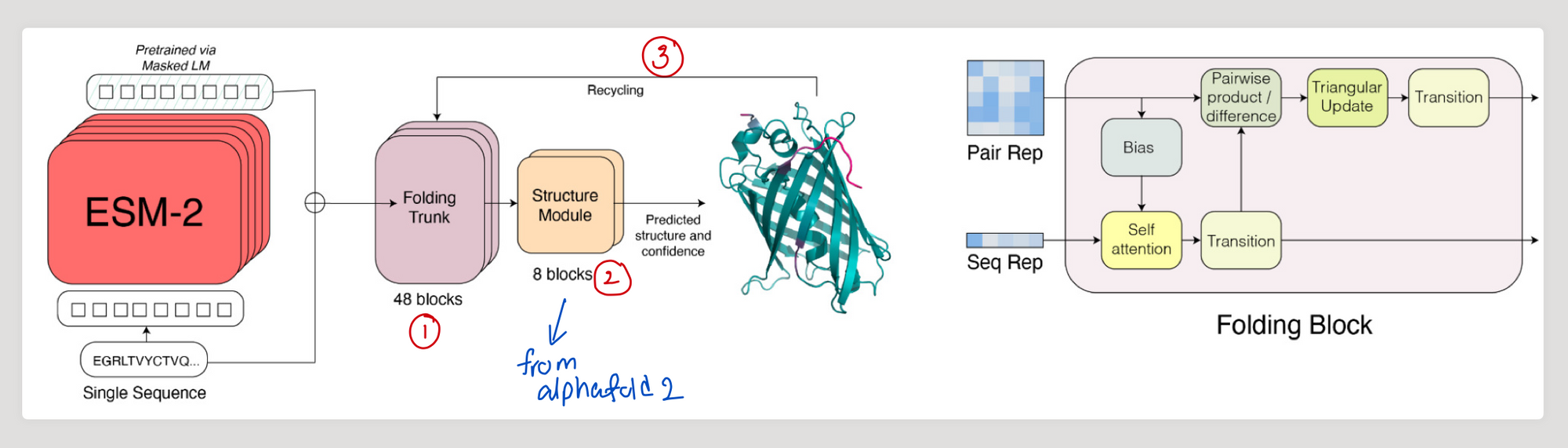
The authors extract contact maps from attention patterns, but predicting atomic spatial coordinates requires an equivariant Transformer. They use the structure module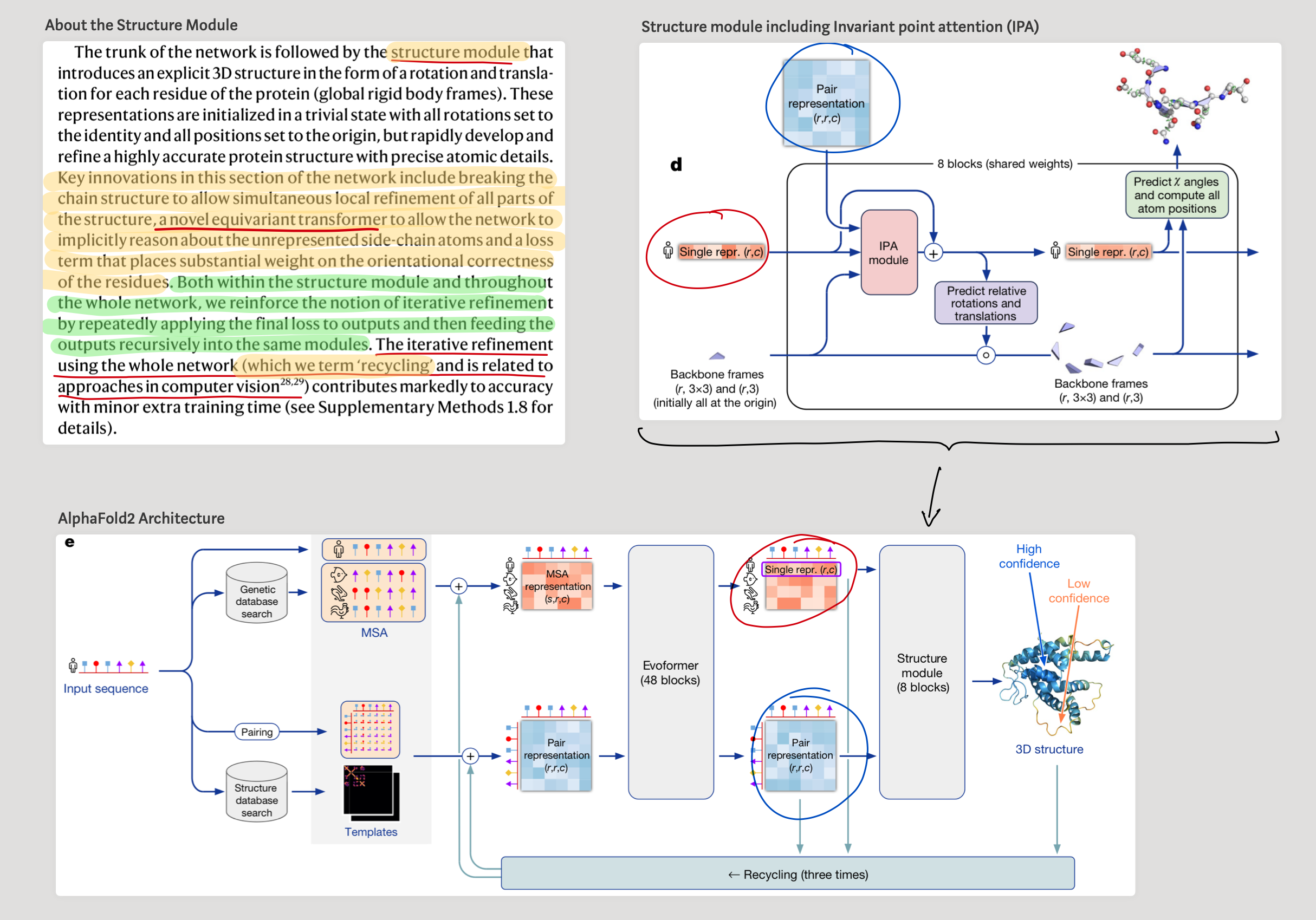 AlphaFold structure module and invariant point attention. introduced in AlphaFold. This module projects atomic spatial coordinates from the language model’s internal representation. The complete architecture is called ESMFold.
Steps in ESMFold
- Process the sequence through ESM-2.
- Pass the representation learned by ESM-2 through a series of folding blocks. Each block sequentially updates a sequence representation and a pairwise representation.
- Pass the result to the structure module.
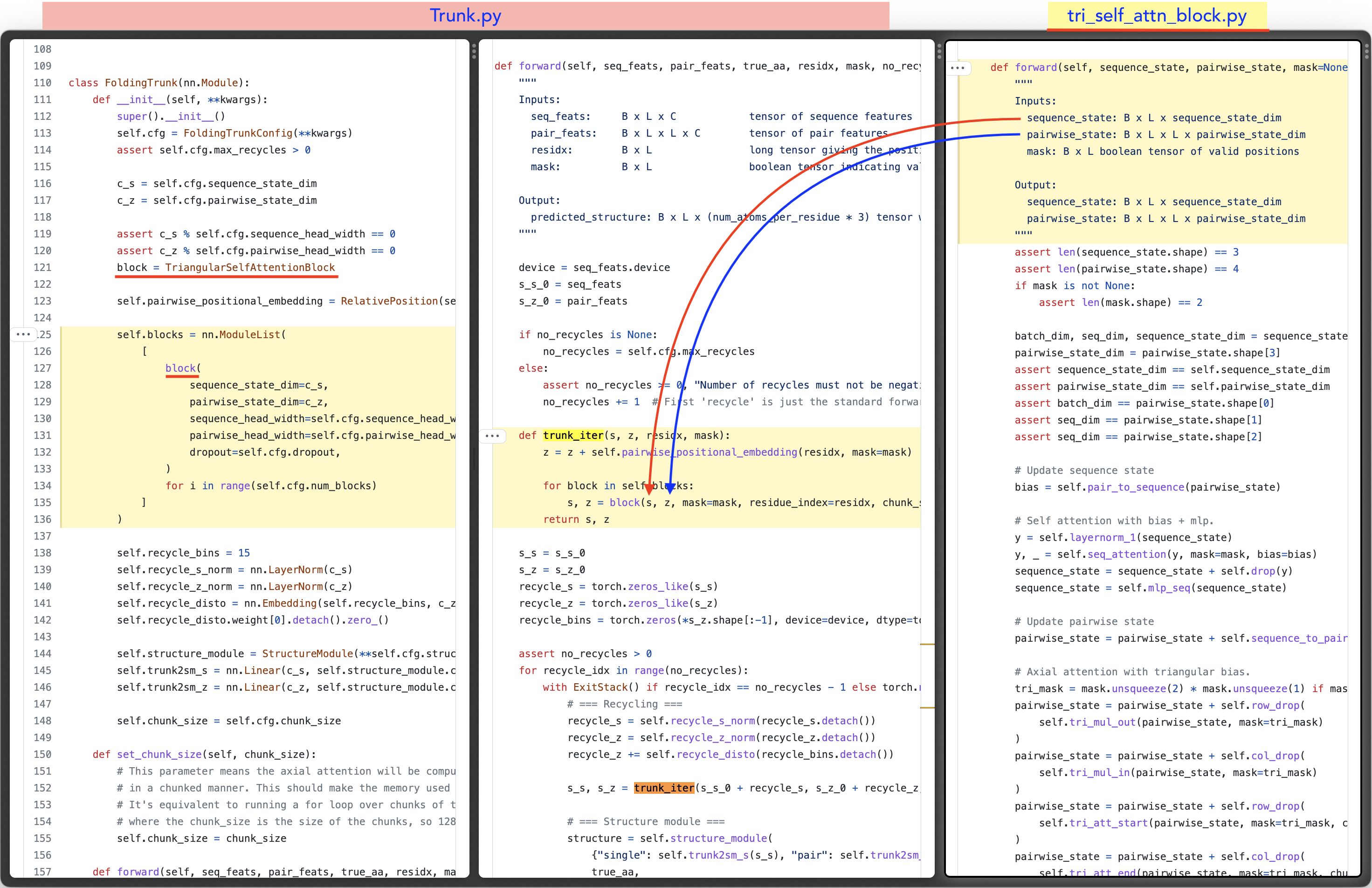
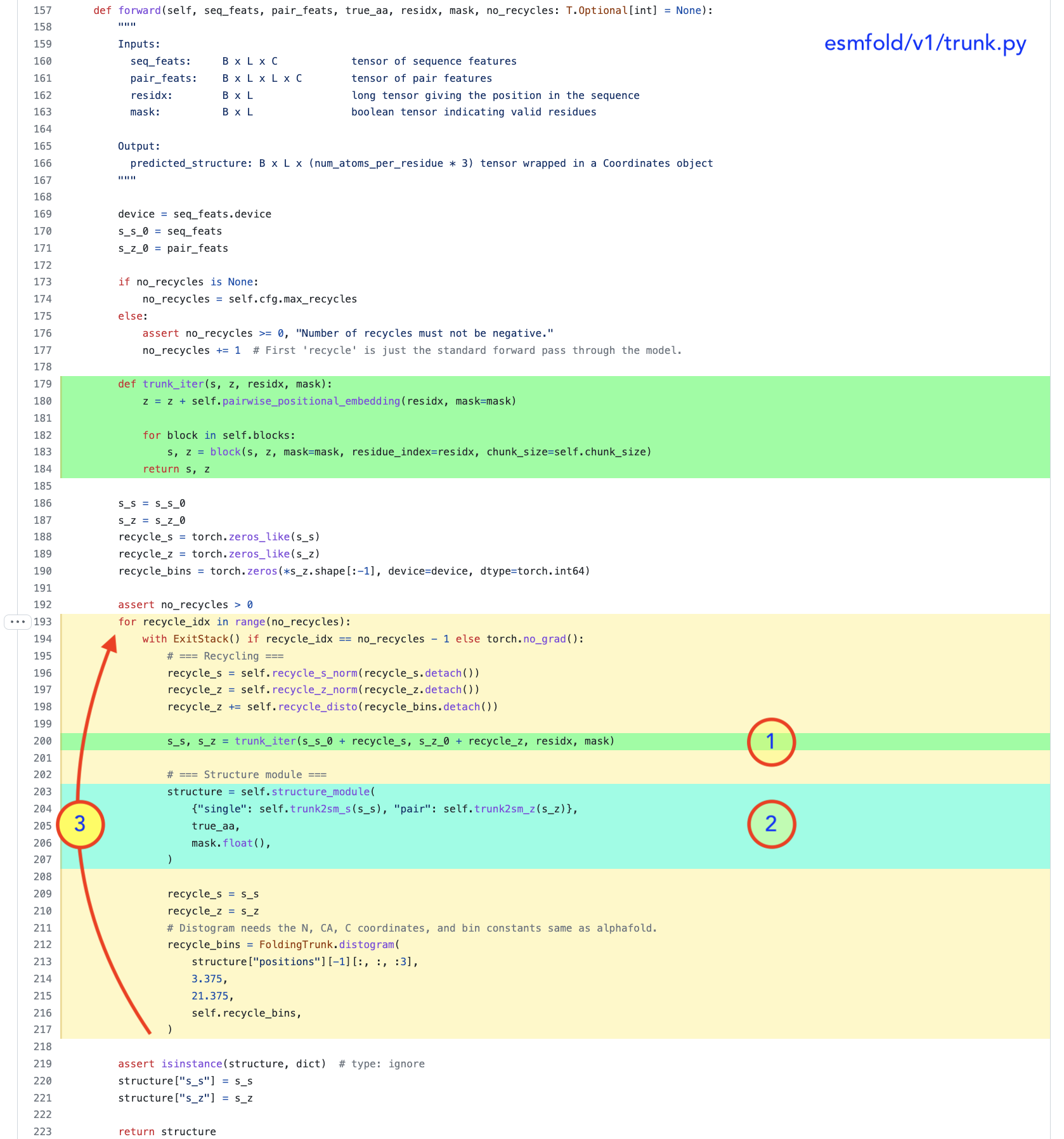
- Repeat with three recycling steps. View annotated code.
The supporting figures connect the structure-module diagram to implementation details. Select any image to open the full-resolution version.
Training: To train the structure model to obtain spatial coordinates, the authors use experimentally determined structures from the Protein Data Bank—approximately 25,000 clusters covering around 325,000 structures. This is augmented with 12 million structures predicted by AlphaFold2.1010 During training, predicted structures are sampled 75% of the time and real structures 25% of the time.
Evaluation: 194 CAMEO proteins and 51 CASP14 proteins.
This language model based approach vastly simplifies the usual SOTA structure prediction process by eliminating the need for the following ,
- External evolutionary databases
- Multiple sequence alignments (MSAs)
- Templates
For example, AlphaFold requires access to these resources.
3. Results
3.1 — How well does it predict structures?
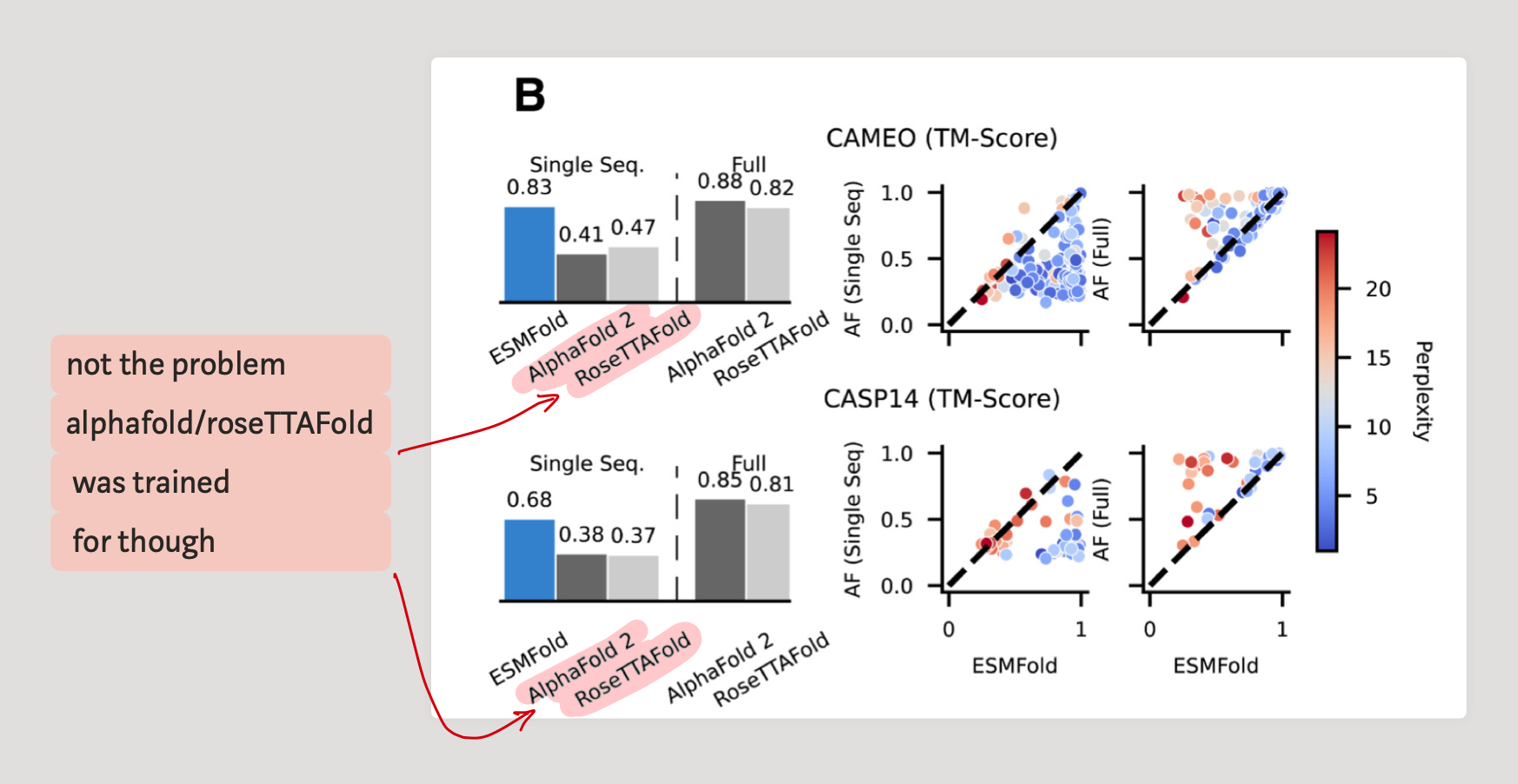
As mentioned before, they evaluate performance on CAMEO and CASP14 proteins and check how well the structure was predicted using the TM-Score.
In predicting the structure just by single sequences, ESMFold achieves very good performance compared to AlphaFold and RoseTTAFold.
3.2 — How important is the language model in the pipeline?
The key question that arises is how important is the representation learnt by the LM for the task of structure prediction . To quantify this we need several metrics.
First, we need to characterize how well the language model understands protein sequences. This is where perplexity comes in. We already have the TM-score to measure how closely a predicted structure matches the ground truth.
Thus, the graph to the right in Fig. 2B shows that,
- High ESMFold TM-Scores have low perplexity scores (numerically speaking, on CAMEO, Pearson correlation coefficient is −0.55 and in CASP14 it’s −0.67)
How can we achieve lower perplexity?
We now know that a better language model representation—with lower perplexity—leads to better structure prediction. How can we obtain a better representation? 🤔 Is scaling all you need?
To answer this question, authors explore the effect of scaling and look at what happens to the following :
- Precision @ L
- Change in perplexity
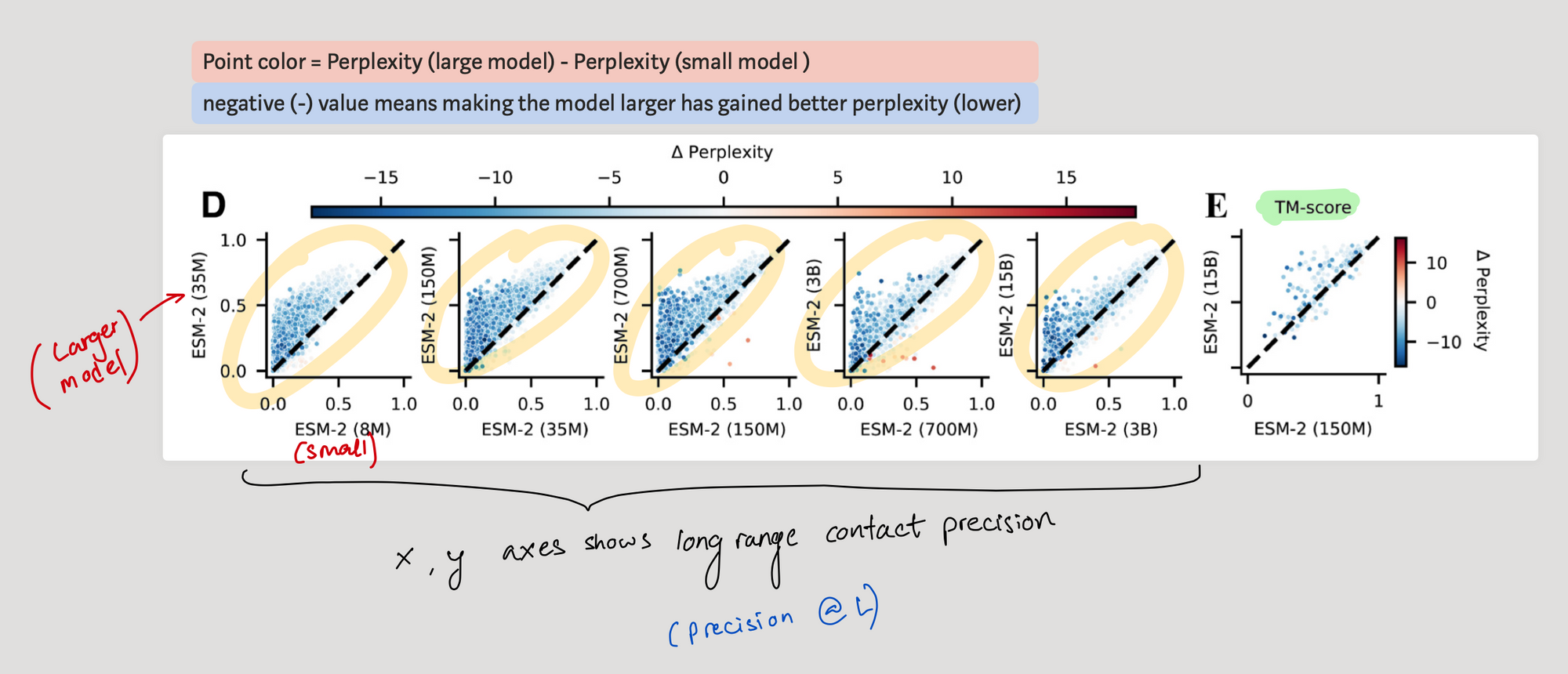
The authors plot how long-range precision at L changes when moving from a smaller model on the x-axis to a larger model on the y-axis. Points above the diagonal suggest that scaling improves long-range precision at L for some proteins.
Is scaling the answer?
It is not that simple. Although P@L increases with scale for some proteins, the number of evolutionarily related sequences tells another story. Language models struggle when less relevant training data is available for a query. This is intuitive—more study, better results—but does it reflect memorization rather than understanding?
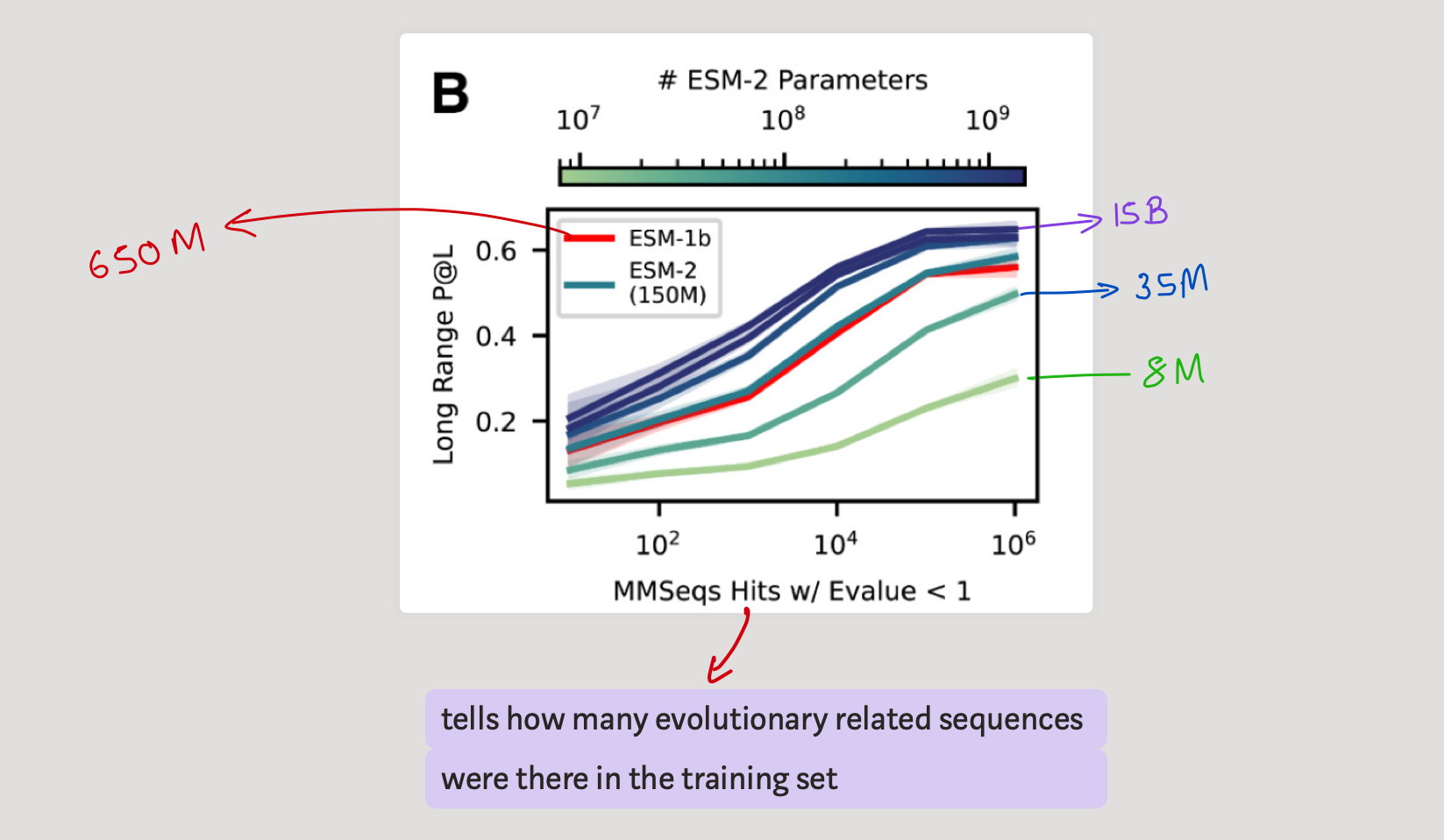
The authors could have used a different color scheme: white points indicate no change in perplexity, while a point on the diagonal indicates no improvement in long-range precision at L.1111 It would be useful if the plot made the proportion of proteins with improved performance directly visible, although that might make it too cluttered.
3.3 — What about prediction speed?
- A protein with 384 residues on one NVIDIA V100 GPU: 14.2 seconds.1212 This is a 6× speedup compared with AlphaFold2.
- Shorter sequences 60x speedup
3.4 — Comparison with other protein language models
4. Conclusion
It’s remarkable that these authors scale protein language models and it has resulted in learning structure hidden through databases of sequences, and thus we do not need to depend onto the MSA.
Is it because, the model has learnt to obtain the signal which we previously obtained through MSAs? What can we tell about the performance of sequences that had less number of evolutionary sequences in training data? why does it still struggle to obtain decent performance. It would be very interesting to analyze these directions.
Thanks for reading this, hope you found it useful. If you have any suggestions/ comments please share below.
References
MoveThanks!